


Google Universal Commerce Protocol (UCP)
What it is, why it matters, and what your business should do now.
What is UCP?
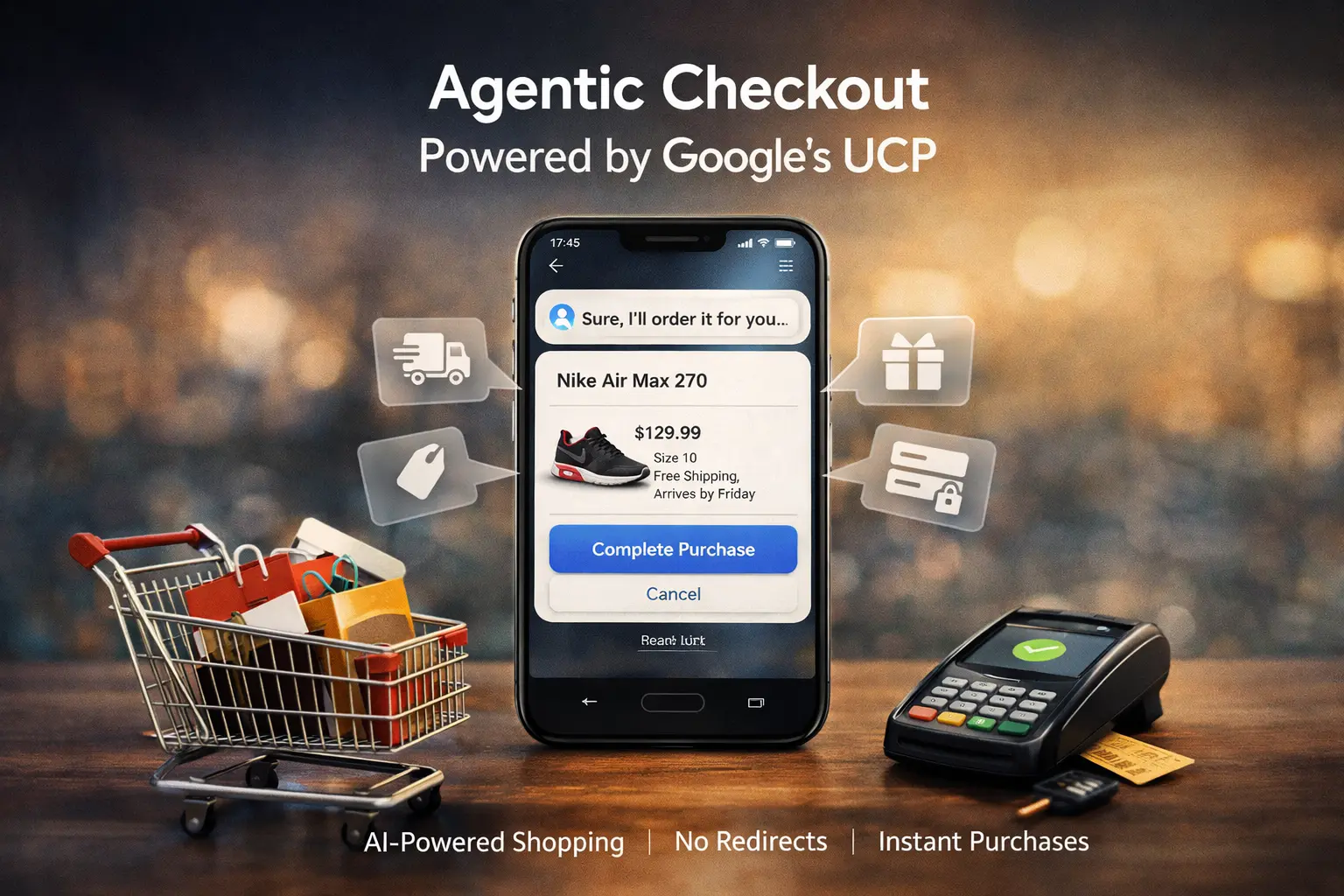
The Universal Commerce Protocol is an open standard from Google designed for agentic commerce. In plain terms, it lets AI-powered surfaces (Google AI Mode in Search, Gemini) complete real purchases on behalf of consumers, directly within a conversation. No redirect. No cart abandonment. The shopper asks, the AI acts, the transaction happens.
This is not a future concept. Google has published the spec, the SDKs are on GitHub, and there is a live waitlist for U.S. merchants. At launch, UCP will power experiences on AI Mode in Search and the Gemini web app, with the Gemini mobile app and additional surfaces planned.
Why This Matters for Your Business
A new transaction channel is forming. AI-assisted shopping is moving from browsing to buying. UCP is the protocol that makes in-conversation checkout possible on Google surfaces. Merchants who integrate early will capture demand that competitors cannot.
You keep control. You remain the Merchant of Record. Your customer data, your relationships, your brand experience. Your Terms & Conditions cover each purchase, just as if the customer checked out on your own site.
Your feed data is the foundation. UCP relies on your Merchant Center product feeds. If your titles, descriptions, images, shipping, and return attributes are incomplete or low quality, this channel will underperform before it starts. Feed readiness is the single biggest determinant of whether UCP works for you or not.
Payments work with your existing stack. UCP passes encrypted payment details to your existing Payment Service Provider. You do not need a Google Pay button on your site. Most major global PSPs already support the token format.
Immediate Steps to Become Eligible
- Join the UCP Waitlist (U.S. merchants). Visit developers.google.com/merchant/ucp and submit your interest. This puts your business in line for early access to native checkout integration on Google AI surfaces.
- Schedule a UCP Feed Readiness Audit with TRIBBUTE Your Merchant Center feed is the single most important asset for UCP. Before anything else, you need to know where the gaps are. TRIBBUTE has built a feed audit system that scores your readiness specifically for UCP requirements. See page 2 for details.
- Claim Your Brand Profile Create or verify your Google Business Profile and Brand Profile to control how your brand voice and guidelines appear across Google surfaces.
- Evaluate Your API Readiness If you are on the legacy Content API, plan migration to the Merchant API. UCP native checkout requires API endpoints for session creation, checkout, order management, and real-time inventory verification.
The timeline is now. Steps 1-3 can be completed immediately and will improve your existing Google Shopping and Ads performance regardless of UCP timeline. Step 4 requires technical planning. The sooner you start, the more prepared you are when Google opens access.
TRIBBUTE UCP Feed Readiness Audit
Know exactly where you stand before UCP goes live.
Your Merchant Center feed is the backbone of UCP. Google has made it clear: product data quality determines whether your products surface in AI-powered shopping, how confidently they are recommended, and whether a transaction can be completed without friction. Incomplete feeds are not just a missed optimization. They are a disqualifier.
TRIBBUTE has built a feed audit system that evaluates your product data against UCP-specific requirements and scores your readiness across the categories that matter for agentic commerce. This is not a generic feed health check. It is built specifically to measure whether your data is ready for what Google is rolling out.
What the Audit Covers
Our Evaluation Criteria for Each Audit Category
Product Identity : Title length and quality (30+ chars), description depth (500+ chars), GTIN coverage, product type categorization, and product highlights
Visual Assets : Image count per SKU (3+ required), resolution compliance (1500x1500px minimum), lifestyle image presence, and video availability
Commerce Attributes : Shipping speed, free shipping indicators, return policy data, sale price annotations, and product ratings. These directly impact conversion rates (2-3% lift per Google benchmarks)
UCP-Specific Fields : Returns information, customer support contact details, policy data, and other attributes required specifically for agentic checkout flows
Brand & Business Profile : Google Business Profile completeness, Brand Profile claim status, brand voice and guideline presence on Google surfaces
API & Infrastructure : Current API version (Content API vs. Merchant API), real-time inventory capability, endpoint readiness for session creation, checkout, and order management
The audit produces a scored report with specific, prioritized actions. Every gap we identify comes with a clear fix and an estimated level of effort so you can plan resourcing. Keep in mind that the majority of feed improvements we recommend will also improve your existing Google Shopping and Ads performance today, so there is no wasted effort here regardless of your UCP timeline.
Common Questions About UCP
Will I lose control of my customer data?
No. You are the Merchant of Record for all UCP transactions. You retain full ownership of customer relationships and data. Your Terms & Conditions apply to each purchase. Standard privacy regulations and consent practices apply to remarketing.
Do I need Google Pay on my site?
No. UCP uses a payment flow similar to Google Pay's facilitated payment, but you do not need a Google Pay button. Your existing PSP receives encrypted payment details. Most major PSPs already support the token format.
Will this affect how my products rank?
No. Opting into UCP does not influence product ranking in listings. However, UCP-integrated offers will feature a direct purchase option on AI surfaces, which could improve conversion from those interactions.
What integration paths are available?
Native integration provides deeper API integration where Google handles checkout within the AI surface (recommended for full agentic capability). Embedded integration routes users to a checkout UX you control, embedded within Google's surface. Both keep you as the Merchant of Record.
Is this compatible with my existing tech stack?
UCP is built on open standards and is compatible with AP2, A2A, and MCP. Google provides native SDKs for common development environments and adapters for other protocols.
Schedule Your UCP Feed Readiness Audit
We will score your Merchant Center feed against UCP requirements, identify every gap, and deliver a prioritized action plan with estimated effort per fix.


